Now to December
Pre-season
Counting down, learning to pack my own parachute, sorting out gear, and jumping a little on weekends. Plus getting the posting habit going before the real jumping starts.
What does it take to jump out of a plane 1,500 times in one year and become a seriously good skydiver? This is where you and I find out.
Scroll to fall. The page is the jump.
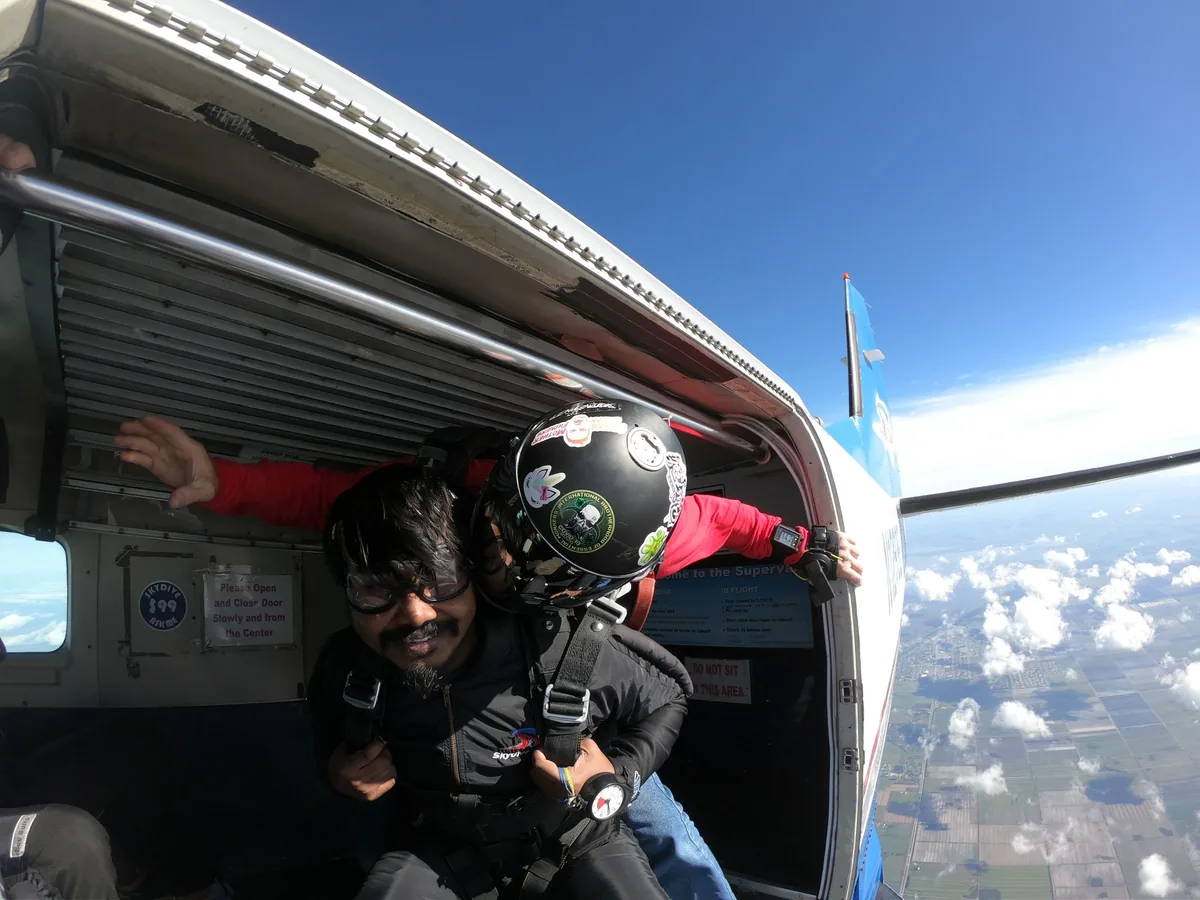
This was me on my first ever skydive, three years ago, in 2023.
Smiling all the way, standing at the door, about to jump out of a plane. Still nervous, still anxious, thinking no, this is not okay, heart beating at God knows how fast. Yet smiling, because I was doing something I'd dreamt of since I was a kid.
And then came silence. The kind I'd never felt before. It then kicked in when I realized I was no longer in the plane but in the air, just cruising down. It felt exhilarating. It felt like home.
When the parachute opened, the calm that came with it can't be explained. I felt a little envious of the birds, and of my tandem instructor at the same time.
I so badly wanted to do it again. Alone, not attached to somebody else.
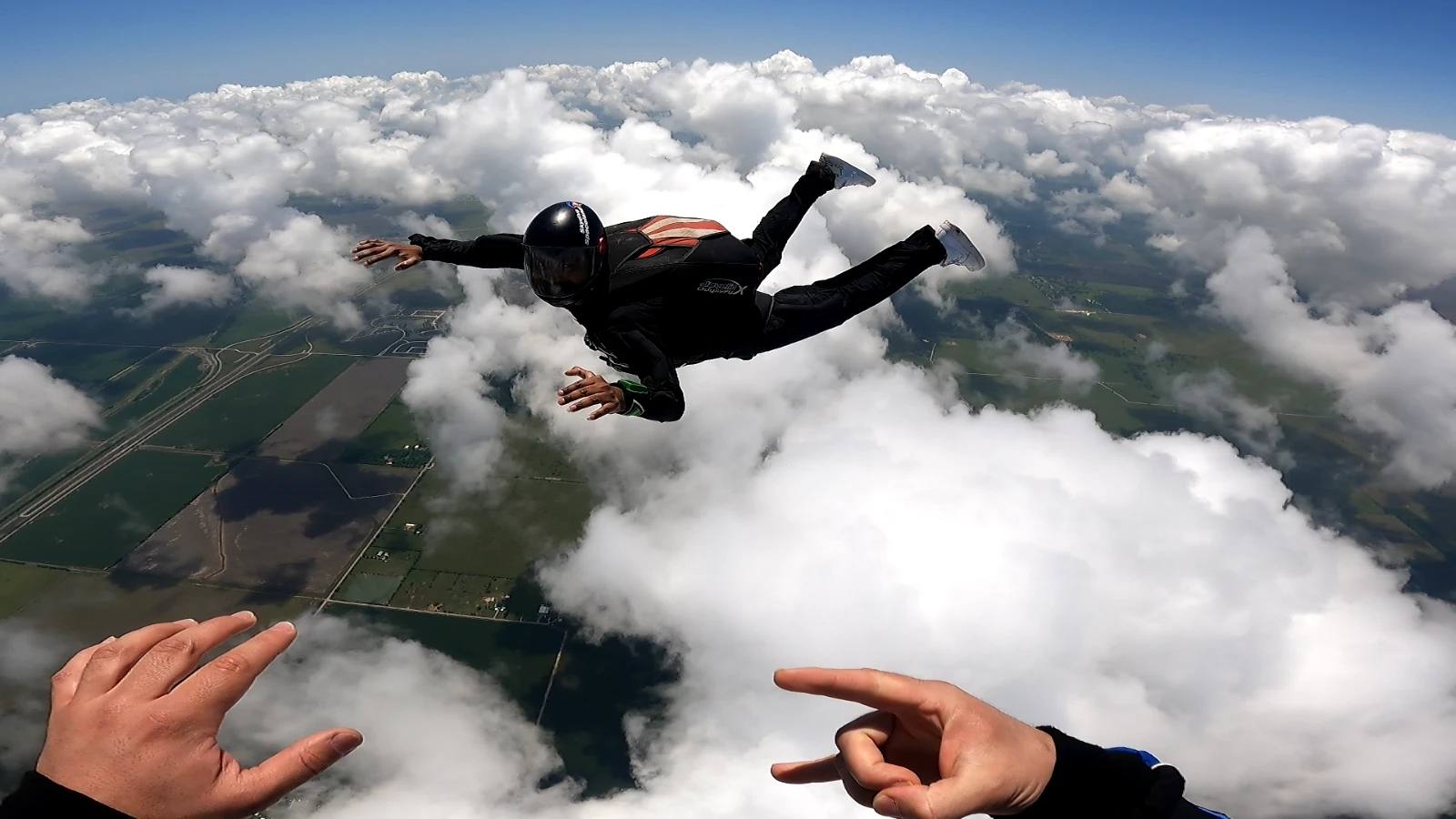
But boy, did I suck at it.
Many repeated jumps, tunnel time and a whole bunch of months later, I got my skydiving A-license. I could now jump alone, anytime, anywhere. How fun.
The sense of accomplishment I felt was unmatched.
You can just do things, I guess.
I kept telling my friends I wanted to do this for the rest of my life. Jumping with people at the DZ was fun, but I wasn't really learning to fly my body. I'm not a natural, and this sport takes more time, money and effort to get good at than most.
So my mind kept saying: later. Fear of failure, the money, fear of injury or worse. So many reasons.
Reasons are just reasons after all.
But when something matters enough, it never leaves your mind. Skydiving makes me feel alive. Going after it will be hard, and that's exactly what gives me a sense of purpose.
A calling.
"Later" had already cost me three years.
So I decided it's high time to go all-in. Yay, finally!
Quitting my job, burning my savings, and going into debt to jump 1,500 times in one year. The only safety net I'm keeping is the one on my back.
Just like millions of Yes Theory's fans, I too am a firm believer in seeking discomfort and facing fear as a way of living.
That's why I'm doing it in public. Because fear shrinks when you can't hide from it. Doing 1,500 jumps in a year takes a toll on both your mind and your body. That's four or five jumps every single day: early mornings, sore shoulders, packing parachutes between loads, and days I'll want to stay on the ground. I can only imagine what jump 1,000 will feel like.
And I want to know
Here's roughly how the year breaks down. It'll shift once the weather and my coaches get a say.
Counting down, learning to pack my own parachute, sorting out gear, and jumping a little on weekends. Plus getting the posting habit going before the real jumping starts.
Five hours in a wind tunnel in Utah. Learning on the ground first, so I'm not wasting jumps figuring it out in the sky.
Belly flying, and a lot of it. Getting stable and comfortable enough that I stop thinking about every move. My USPA C and D licenses land in this stretch too.
Freefly, VFS and angle flying. Flying head-up and head-down for the first time, and probably sucking at it all over again.
Wingsuiting, once I've got the jump numbers and my coaches say I'm ready. Not before.
Last landing of the year. Then the real goal: coaching ratings, and soon taking people on their first tandem skydive.
Five disciplines in one year. Some I've barely touched, one I've never tried. All of them are going to humble me.
Jumpers fly in a stable, belly-to-earth orientation and link grips to build geometric shapes and formations in groups.
Performers use multi-orientational body positions, including sit-flying, head-up, and head-down, to achieve faster vertical speeds and dynamic routines.
An advanced offshoot of freefly where teams hold grips while maintaining vertical head-up or head-down orientations.
Skydivers fly diagonally or horizontally across the sky at high speeds in close proximity, trading vertical descent for directional movement.
Pilots wear specialized fabric suits with webbed arms and legs to convert vertical gravity into long, sustained horizontal glides.
Jump 1/1500 is January 1. Come along.